Hospice Care Kenya
Registered Charity 1001709
Newsletter Winter 2004
|
|
Hospice Care KenyaRegistered Charity 1001709Newsletter Winter 2004 |
|
|
| |||||||||
Letter from the Honorary Treasurer | |||||||||
E - X - P - A - N - S - I - O - N ! That is what struck me on a visit to the Kenyan hospices in November. Coast Hospice has opened up work at Malindi; Kisumu now has a satellite at Siaya and Nyeri has set up at Nyahururu with another satellite in prospect at Kerugoya. All this has been achieved with limited resources but plenty of enthusiasm. Your donations have helped in this work by funding the training of nurses and doctors and also by raising a considerable part of the money required to buy vehicles. |
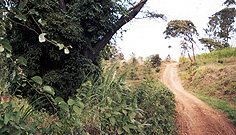
Much of the work is carried on in rural areas with dirt roads, poorly
maintained. This means that rugged four wheel drive vehicles
are essential and they are not cheap. We have requests for
funding from two hospices for such vehicles and I am sure there will
be more before long. Please keep this in mind as you turn to
the articles in this newsletter asking you to exercise your generosity.
Wherever I went the request was to pass on greetings to all the donors in the UK and I gladly do this together with all good wishes for Christmas and the New Year from HCK staff and trustees. Brian Lloyd
| ||||||||
The Malaika Ball 2005 - tickets on sale now!YOUR EVENING OF FUN WILL CHANGE SOMEONE'S PAIN INTO COMFORTMarch 19th 2005 at the Bristol Marriott Royal Hotel, Bristol
|
| ||||||||
A CASE STUDY FROM COAST HOSPICEIt was on 10th November 2002 that Abigael decided to have a doctor friend check some swellings on her neck: little did she know that this was going to be the beginning of her trips in and out of hospitals. The doctor told her husband that he would put her through a regime of 15 injections at 600 Ksh each. Not knowing what these injections were for but wanting his wife to recover, he paid up. With no tangible change the same doctor then referred her to a private hospital in Mombasa where she was x-rayed, again with no tangible result. They were then referred to yet another private hospital, this time in Nairobi, where a battery of tests was done without apparently revealing anything. Finally in January 2003 a doctor from the Coast Provincial General Hospital did a biopsy and cancer was detected and chemotherapy and/or radiotherapy proposed. 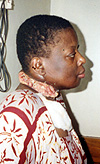
By February 2003 the neck growth had swelled into a large tumour. Unfortunately due to the long wait for radiotherapy the tumour burst, which prompted emergency radiotherapy. After 36 continuous days of treatment the wound started to heal. A very small sore remained and Abigael was discharged and given an appointment for a month later. When she went back, they found that the wound, instead of healing, had festered inside and from there it just got worse. A nurse at the ENT clinic told Abigael and Nicholas about the Coast Hospice and a referral was made. The Hospice staff dressed the wound regularly and taught her husband to do the same; drugs for pain management (morphine and others to relieve other symptoms) were administered. Regular home visits by the staff were truly appreciated by Abi (Agirlbaby, as she was fondly called by the Hospice staff) and the other family members. Nicholas says of the Hospice, �kama ni kuishi na watu wa Hospice� (given the chance he would love to live with the hospice team - Ed). The Hospice staff gave Nicholas and Abi a better understanding and acceptance of the illness. It was only after the Hospice took charge, that she was able to eat, sleep properly and be in high spirits despite her condition. Unfortunately Abigael passed away in February 2004: she was 34 years old. Nicholas still visits the hospice, not only to clear his bill but also to say �hello� and show his appreciation. Nyandia Nderitu | PATIENT PROFILE FROM NAIROBII am a 35 year old female and the 8th born in a family of twelve children. I'm a patient at the Nairobi Hospice. I began feeling unwell in May 2003, with very serious chest pains, breathlessness and also serious difficulties when passing urine. The problem of passing urine became worse in the month of August 2003. My health was deteriorating rapidly because I was not getting proper treatment due to lack of finance to pay my hospital bills. I was depressed, desperate and in a hopeless situation until I met a friend who took me to the Nairobi Hospice. At the hospice the doctors and nurses attended to me promptly. Within a short time my health improved. I also stopped wearing baby diapers to protect myself from uncon-trollable passing of urine. Since then I have become a patient of the Hospice where I'm well taken care of. It was in the month of February 2004 when I had a stroke and was paralyzed on the left side of my body from my head to my toes. My left hand and leg were completely paralyzed. I could not sit, move or walk on my own and I had to rely on a wheelchair. Thanks to the Hospice staff who took care of me, I can walk, go on duty and do all my daily chores. When I was paralyzed and unable to walk and feed myself, the Hospice made sure that someone came to the house to take me to and from the hospital for treatment. At the Hospice, the medical team offered me holistic care. I remember them telling me that I should not worry nor be scared of being in a wheelchair. They kept on telling me that all was going to be well and that they cared and loved me so much. They helped me do some physiotherapy on my leg until I was able to walk on my own. Thanks to the Hospice team!! The day care service offered by the Hospice on Thursdays has put something into my life that I cannot express in words. The driver picks me up from my house every Thursday morning to attend the daycare and drops me back. On arrival at the Hospice, we find the volunteers waiting to welcome us at the door or at the entrance. With a sweet smile and a hug they direct us to the hall where we have all sorts of entertainment. The volunteers keep telling us that we are worthy and resourceful just like any other healthy persons. We eat and drink together then go home feeling so much loved and cared for and we also never leave the Hospice empty-handed. We are always given something to take home for our meals. 
Vindorise I can never be grateful enough to the staff at Nairobi Hospice for the good work they are doing in helping many to cope with serious ailments which really need palliative care. Thank you Hospice for putting life in my days and not just days into my life. I can now afford a smile on my face and hope to live a longer life. Thank you. |
PALLIATIVE CARE IN RURAL AREAS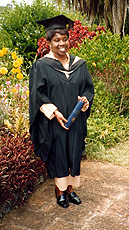
Margaret receiving her Patients coming from hospitals with pathology results that were never explained to them is common. The agony of patients having to learn they have a cancer they have never been told about is all too painful to bear. Palliative care is the active total care of patients whose disease is not responsive to curative treatment. Control of distressing symptoms especially pain, as well as addressing psychological and social problems is paramount. Palliative care aims to achieve the best possible quality of life for patients and their families as well. Though the disease has no cure, palliative care seeks to relieve, reduce and where possible, prevent occurrence of distressing symptoms. This care is now available in Kenya. The initial programme began in Nairobi Hospice in the early 1990s and Nyeri Hospice soon followed. Many other hospices have come up since then and numbers are growing. Currently the state of management of patients with terminal cancer or HIV/AIDS is very demanding and teamwork is encouraged. Apart from the medical team, the patient, the family and the community are the key to the success of this care. Volunteers from the community are there-fore important; people who are willing to take some time and make efforts in identifying the needs of the patient and family. Nyeri Hospice organizes volunteer training once or twice a year. The greatest challenge is lack of resources. Thinking of a woman who had suffered bleeding for many years (possible cancer of the uterus or cervix) reminded me of the woman in Mark 5:25-26 who had used all her money under the care of many doctors but instead of getting better, she got worse. This situation is very real today. People become victims of retrenchment when some institutions are cutting down on staff numbers and this makes it very hard for palliative care providers to give adequate care. This means that some-one has to donate towards the cause. The challenge of care is great. The suffering of another human being should touch us all. Palliative care in rural areas is essential, but long distances, lack of transport and even lack of knowledge challenge the intent to ensure that last days are not lost days. Have you ever thought of your last two weeks of life on earth? How would you like to face them? How would you want to spend them? All have a duty in providing comfort. You can do this by giving your money, time and skills wherever you are. Consider yourself able as the work continues. Margaret Mbogo, CEO Nyeri Hospice |
NYERI HOSPICEOur Open Day on 16 October 2004 was a memorable day for us all. Although rainy and muddy, people turned out in large numbers. The British High Commissioner to Kenya, Mr. Edward Clay, was the guest of honour, and after his speech he planted a memorial tree at the hospice. The heavy rains worked to our advantage, as the provincial commissioner, also present, promised to have the dirt road leading to the hospice repaired. 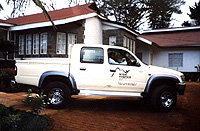
Our new 4WD pick-up was conspicuously displayed for viewing by our guests, who were encouraged by the achievement. Thanks to Hospice Care Kenya, the Beatrice Laing Trust, the Swire Charitable Trust and the Trusthouse Charitable Foundation in the UK, Starbucks Switzerland, and all our supporters over the years. We are now able to leave for home visits early and are able to reach more patients daily. Florence Kiama NYAHURURU HOSPICEI must start by appreciating the work HCK is undertaking in assisting Hospices in Kenya. Thanks for the commitment in helping the terminally ill and the less fortunate in our community. Nyahururu Hospice is run by two full-time and two part-time nurses, all under the ministry of health. We operate in two rooms where two other services run concurrently. Congestion is a major problem but we try our level best to provide the best possible care for the patients and their families. The Ministry of Health has offered us a place to build our premises but we have no resources to put up the building. We have only managed to visit 14 cancer patients and their families, due to lack of transport. Home visits are a paramount service to the very sick and frail patients but it has been almost impossible because we have no vehicle. We have tried public transport but it didn't work as our patients come from very remote places. Our fundraising walk on 2nd of October 2004 was good publicity and we raised a total of Ksh 300,000 (�2,000) for buying drugs, especially morphine and codeine phosphate. I am very grateful to HCK for its kind support in paying my diploma tuition fee. With the knowledge attained I will be able to work more accurately and effectively. We look forward to your kind support to enable us to stand on our own and help the terminally ill patients in our poor rural community. Mrs. Jane Riungu |
ELDORET HOSPICEOn 27th October 2004, a ceremony was organised to mark Breast Cancer Month at Eldoret Hospice. The main objectives were to create awareness and do breast examinations. It was well attended by people from all walks of life. There was representation from the Sikh Community and students from Rift Valley Technical Institute among others. Eldoret Hospice board members were present and the chief guest was the District Commissioner, Uasin Gishu District, Mr Andrew Gitonga. After the official launch, breast examination proceeded and was conducted by the Hospice staff in collaboration with doctors from Moi Teaching and Referral Hospital. A total of 86 clients were examined: 6 men and 80 women. Five had abnormalities and were referred to Moi Teaching and Referral Hospital for further investigation. P H Asige 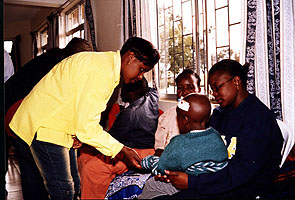
Day Care Services at Eldoret Hospice KISUMU HOSPICE & PALLIATIVE CARE CENTREKisumu Hospice has now been in operation for six years, and we have recently extended our services to include HIV-AIDS as well as cancer patients. We also provide palliative care services to the Burkitts Lymphoma children in Nyanza Provincial Hospital, where they are admitted for both curative and palliative care. Every October we organize cancer prevention and early detection activities by carrying out cancer awareness programmes and organising pap-smears in conjunction with the Family Planning Association, and breast cancer awareness and mammography with Nyanza Provincial Hospital since we do not have the equipment in the hospice. The move to open a branch in Siaya is in response to the Kenyan Govenment plan to have palliative care in every government hospital. Dr Julius Onyango, Extract from Annual General Report |
VEHICLESIn the last two years, with your help we have funded or helped to fund the purchase of three 4x4 vehicles for the hospices in Mombasa (Coast), Kisumu and Nyeri. Such vehicles are vital for home visits. What follows is a poetic plea from Meru Hospice for a vehicle of its own. By Dr Bactrin Killingo
|